
A master file that is always inspection-ready
Nirnāśā PSMF isn't a document you update once in a while. It's a controlled output of a continuously synchronised model of your pharmacovigilance system: structured data, annexes, ownership, approvals, change tracking and QPPV oversight in one secure platform.
A digital twin of your pharmacovigilance system
Your PSMF is regenerated from the facts, so the document can never drift from reality.
Structured master data
QPPV, products, vendors, agreements, computer systems and PV processes are held as registers, and those registers generate the annexes.
Event-driven change detection
A change to master data is detected as it happens and routed for impact review. Nothing waits for the annual refresh.
PSMF impact graph
Dependency chains show exactly which sections and annexes a change touches, with a "why" path you can check.
Human-governed AI
Six agents draft, check and map. No AI method ever changes a workflow state on its own.
QPPV oversight
Risk-scored approval routes, review cadences and oversight dashboards built around the QPPV's legal responsibilities.
Point-in-time reconstruction
Bi-temporal records answer both "what did the file say" and "what did we know" on any past date.
Controls regulators can recompute
From risk-scored routing to a compliance score that isn't produced by a model, every number in Nirnāśā PSMF can be traced to its inputs.
- Risk-scored approval routing. Each change is scored on five dimensions (0–25), and the score sets the approval path and signature level.
- EU IR 2025/1466 enforced as state. Unapproved subcontracting blocks publication, and agreements missing required clauses can't go live.
- Deterministic compliance score. Seven weighted components with every input shown, so an inspector can recompute it.
- Global-to-local propagation. Controlled inheritance and local override, with national templates.
- What-if simulation. Model a vendor replacement before you commit, without touching live queues.
- Annex I logbook & redlines. The logbook is kept automatically, with word-level comparison between versions.
New safety-database vendorImpact review
§2.4 Computerised systems → Annex C, Annex EWhy path
QPPV + QA approval routeRouted
Subcontractor not yet approvedBlocked
SHA-256 bound signaturev15
From onboarding to inspection response
Set up
Configure the tenant, organisation structure, roles and signature policies.
Load master data
A guided bulk load with a real dry run before anything is committed.
Link evidence
SOPs, agreements, audit reports and training records attached to what they support.
Author & regenerate
Author the seven GVP Module II sections, and annexes regenerate from the registers.
Sign & publish
Publication blockers are checked first, then e-signed release with a full redline.
Maintain & respond
Periodic reviews, change routing and a seven-day inspection mode.
Ready when the authority calls
Seven-day clock
The deadline runs from the authority's request and is then frozen. The dossier lists what it can and can't evidence.
Time machine
Reconstruct the PSMF exactly as it stood on any past date, for any inspection period.
Vendor oversight
Vendor scorecards with RAG status and a vendor portal that shows each vendor only its own evidence.
Annex I & evidence agents
Draft logbook entries and check that linked evidence really supports each claim.
Consistency agent
Checks global against local, and PSMF against PV agreements and SOPs, for contradictions.
Ask your master data
Natural-language questions answered from your registers, and labelled when they're rule-derived.
Built on the regulations that define it
GVP Module II
The full section catalogue, plus GVP Module I and Directive 2001/83/EC references.
21 CFR Part 11
Signatures bound to content with SHA-256, and clause-by-clause technical checks.
EU GMP Annex 11
Backups with restore testing and a hash-chained, append-only audit trail.
GAMP 5 package
VMP, URS, RTM, IQ/OQ/PQ, a risk assessment and a DR runbook.
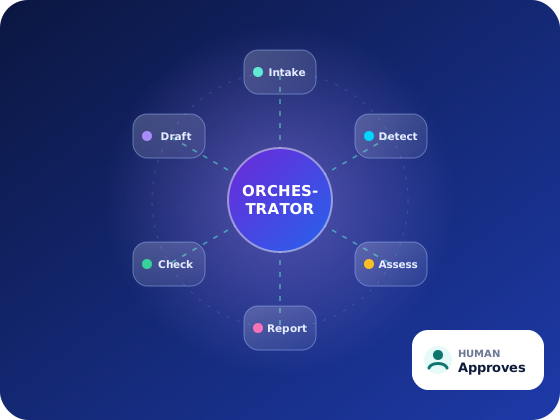
Six agents, one accountable QPPV
Human-governed agents draft, check and map, and no AI method ever changes a workflow state on its own.
Regulatory & evidence agents
Check that linked evidence really supports each statement.
Change-impact agent
Traces which sections and annexes a change affects.
Ask your master data
Plain-language questions answered from your registers, labelled when rule-derived.
Your choice of model
Works with an OpenAI-compatible endpoint or a self-hosted model.
Explore the connected suite
Make your PSMF a living system
See change-impact tracing, point-in-time reconstruction and inspection mode in a guided walkthrough.