

Every safety signal starts at intake
Nirnāśā PV Intake brings calls, emails, forms, published literature and social media posts into one AI-assisted queue. It extracts and classifies each report, suggests codes, checks seriousness and flags duplicates, then hands clean cases on to processing.
One platform for every source of safety data
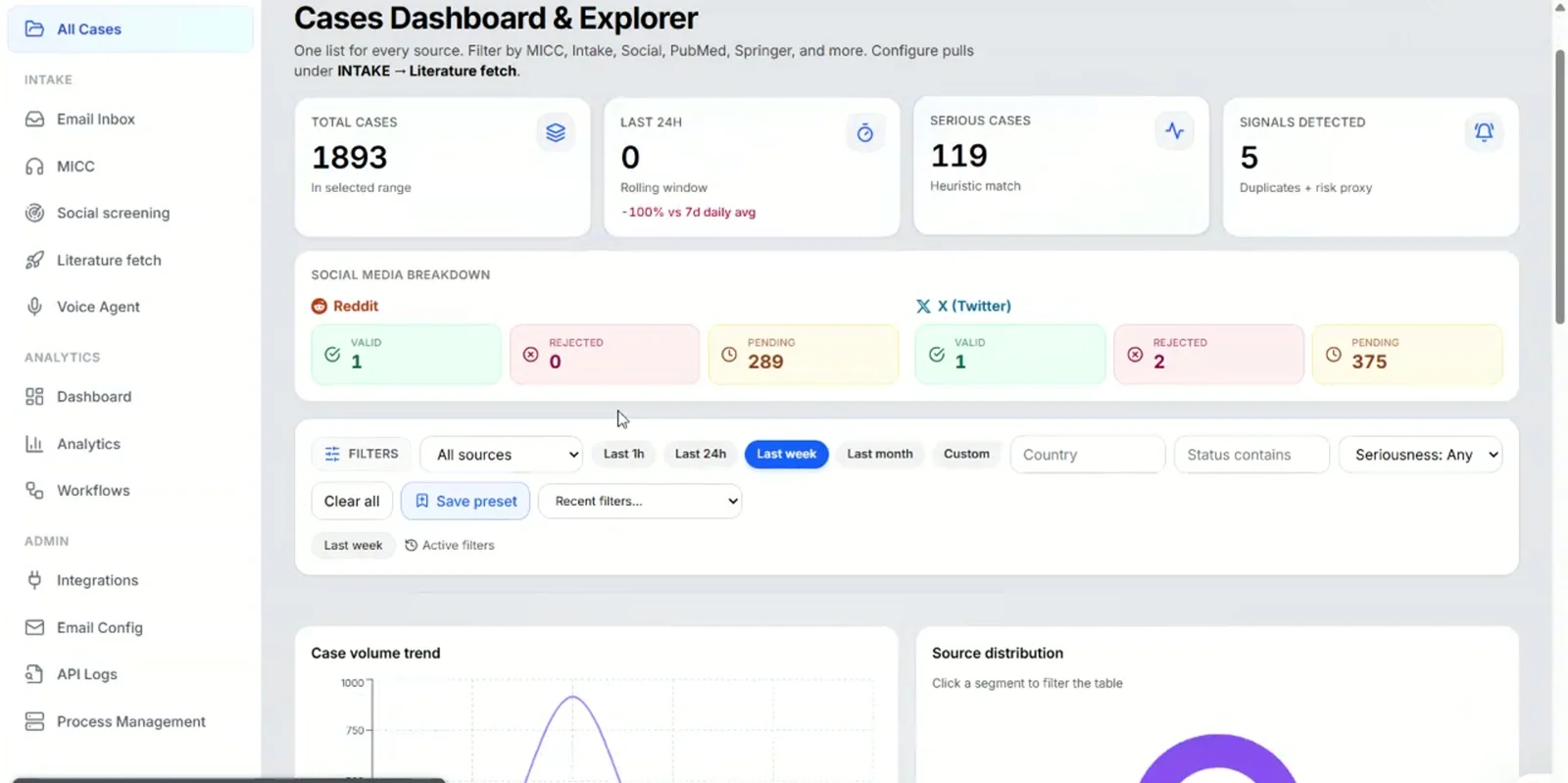
Each channel has its own purpose-built workspace, and all of them feed the same master adverse-event record.
Turn every call, email and form into a structured case
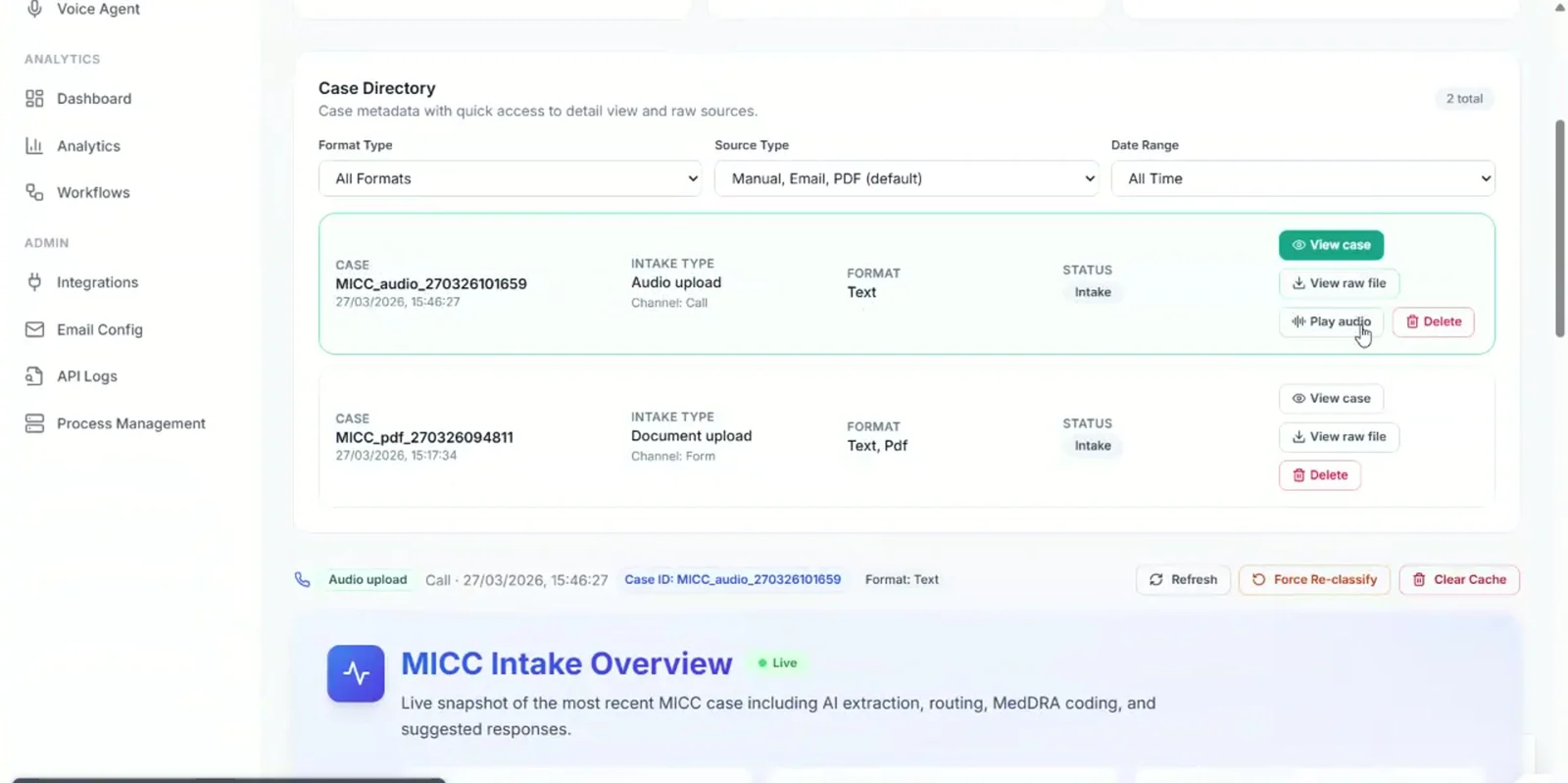
MICC handles medical inquiries, adverse-event reports and product complaints from ten channels through a single path. Each contact keeps its original source file and is tagged with the channel it came from.
- Ten-channel intake. Intake desk, email, chat, call, web, form, fax, API, social and E2B import.
- Any document format. PDFs (with OCR for scans), images, Word, CSV and email combined into one narrative.
- Call recordings to text. Audio is transcribed and processed like any other written report.
- AI field extraction. Reporter, product, dose, route, lot, patient, event, dates and seriousness, each with a confidence score and source.
- Four-way classification. Medical inquiry, adverse drug event, product complaint or non-case. One contact can carry more than one.
- Pre-filled forms. A form for each classification, pre-filled with the AI values, plus suggested replies to medical inquiries.
Transcribed · EnglishComplete
Product A · 50 mg · oral · rash96% confidence
Adverse event + medical inquiryConsensus
Non-serious · 90-day clockDue 27 Dec
Drafted for HCP inquiryReview
Screen literature at scale, without missing a case
Saved search strategies run the same way every cycle. AI triage separates ICSR-relevant articles from background noise, and full-text retrieval brings in the paper so the case can be extracted.
- Repeatable search strategies. Saved queries with a set date window, which AI can draft from a plain-language brief.
- Literature sources. PubMed (NCBI) and Springer, plus manual upload of abstracts and PDFs.
- Two-stage AI triage. A fast keyword filter, then AI sorts each article as ICSR-relevant, safety-relevant or not relevant, with a score and reason.
- Full-text retrieval. Tries PubMed Central, Europe PMC, Unpaywall, Crossref, Semantic Scholar and OpenAlex, then the publisher.
- One draft case per patient. An article describing several patients becomes several draft cases.
- Four-layer de-duplication. DOI/PMID match, normalised title, meaning-based similarity, then an AI check.
- Human override, fully recorded. Reviewers can overrule the AI. The reason, the user and the AI's original verdict are all kept.
312 hits · 41 newComplete
DOI · title · semantic271 matched
6 ICSR-relevant · 9 safety-relevantReview
"Case report" section locatedEurope PMC
3 patients → 3 casesCreated
Hear the patient voice, and filter out the noise
Monitor Facebook, LinkedIn, Reddit and X for adverse events. A strict patient filter sets aside marketing, news and recruitment posts so reviewers only see genuine first-hand reports.
- Four platforms. Facebook, LinkedIn, Reddit and X, each with its own screening workspace.
- Real-time Facebook webhooks. Posts on Pages you run arrive within seconds, so the reporting clock starts when the patient posted.
- Strict patient filter. A post must come from a patient, caregiver or HCP, confirm the drug was taken, and include clinical content.
- Transparent rejections. Every excluded post is logged with its category, reason and score.
- Social triage. Adverse event, medical inquiry, product complaint or non-case, before any case is created.
- Drug and MedDRA matching. Meaning-based matching to MedDRA terms, plus a table of drug brand and generic aliases.
- Promotion to MICC. Approved posts become social-channel cases, and serious ones start the regulatory clock.
Page comment · 3 sec agoLive
First-hand · drug taken · symptomPassed
Lawsuit ad · reason loggedRejected
"Can't sleep" → InsomniaPT match
Social-channel caseClock started
Real screens from PV Intake
From first contact to a case ready for processing
Capture
Reports arrive from any channel, and the original source file is always kept as evidence.
AI processing
Extraction, classification, MedDRA suggestions, seriousness triage and duplicate checks run automatically.
Processor review
Case processors confirm or correct the pre-filled form for each classification.
Medical review
Physicians assess seriousness, expectedness, causality and reportability for each event.
QA review
Quality reviewers approve, reject or raise a query back to medical review, with e-signature.
Hand-off to ICSR
Approved cases move to the ICSR Suite, linked in both directions, for E2B(R3) processing.
Automation that keeps working, even when AI can't
Three-level fallback
If the AI model is unavailable, a machine-learning classifier takes over, then a rules engine, so intake keeps moving.
Parallel batch processing
AI steps run in parallel batches from a queue that survives restarts and retries failed items on its own.
PHI masking
Names, dates of birth, phone numbers and other identifiers are removed before text reaches a language model.
Explainable decisions
A plain-language summary and rationale for each AI decision, logged with the model and prompt version.
Low-confidence flags
When a result came from a fallback method, it is flagged so a person confirms it.
Operations dashboards
Case aging, submission timelines, follow-ups due, QA metrics and AI usage cost in one place.
Audit-ready from the first contact
Controls follow GVP Module VI, ICH E2B(R3) and ALCOA+ principles.
Append-only audit trail
User, IP and timestamp captured at every step, and database-enforced so entries can't be altered.
Electronic signatures
21 CFR Part 11-style signatures that require a stated meaning and reason.
Regulatory clocks
15-day serious and 90-day non-serious timelines, both configurable.
No hard deletes
Cases are withdrawn with a required reason, and original evidence is kept.
Connected sources & integrations
AI that reads every report before anyone opens it
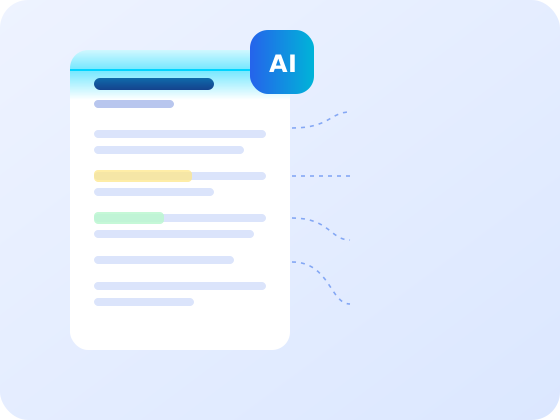
Language models extract, classify and check each contact. Every result carries a confidence score and its source, and a person confirms it.
AI field extraction
Reporter, patient, product, dose, event and dates, each with a confidence score and source.
Model consensus
When models disagree on the classification, a consensus step reconciles them.
Literature triage
AI sorts articles as ICSR-relevant, safety-relevant or not relevant, with a reason.
Patient-post filter
Social posts must be first-hand, confirm the drug was taken and include clinical content.
Explore the connected suite
Bring every intake channel into one queue
See MICC, literature and social media monitoring working together in a live walkthrough.